

Trust and Knowledge Sharing: Understanding the Trust Cycle
The Paradox of Knowledge Sharing
Organizations invest millions in knowledge management systems, collaborative platforms, and information technology infrastructure. Yet knowledge sharing remains stubbornly difficult. The most sophisticated document management system cannot force an experienced engineer to share their hard-won expertise. The most advanced AI cannot convince a talented manager to mentor a colleague. Technology enables knowledge sharing, but something else determines whether it actually happens.
That something is trust.
Trust is not a static attribute that exists or doesn't exist. Rather, trust is a dynamic cycle—a continuous process of judgment, decision-making, action, and re-evaluation. Understanding this trust cycle is essential to understanding why knowledge sharing succeeds in some organizations and fails in others.
The Trust Cycle: A Framework for Understanding Knowledge Sharing
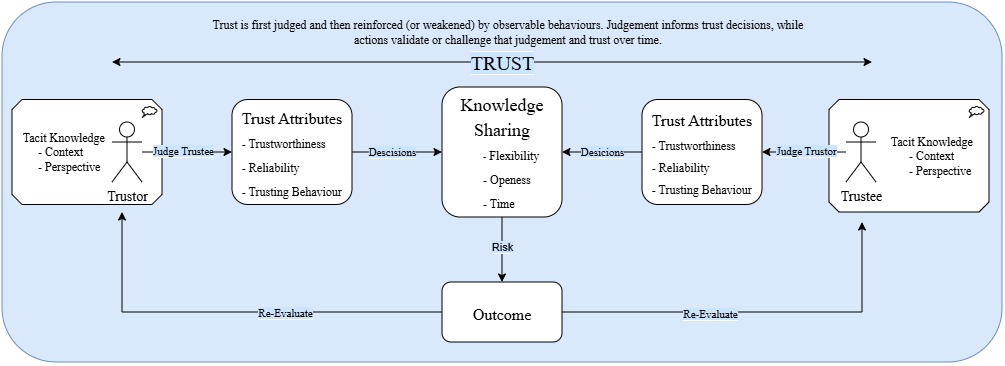
The trust cycle begins with a fundamental principle: Trust is first judged and then reinforced (or weakened) by observable behaviours. Judgement informs trust decisions, while actions validate or challenge that judgement over time.
This principle describes a continuous loop that shapes whether individuals will share knowledge. Let us walk through each stage of this cycle.
| Category | Attribute | Definition |
|---|---|---|
| Trustworthiness | Competence | The trustor has the skills to produce the outcome. |
| Integrity | Being genuine and true to oneself in the relationship, fostering trust through honesty and transparency. | |
| Consistency | Maintaining stable and predictable behaviours over time, reinforcing trust and reliability in the relationship. | |
| Benevolence | Demonstrating goodwill, kindness, and genuine care for the other person’s welfare, without expecting anything in return. | |
| Boundaries | Respecting and honouring each other’s boundaries and privacy, fostering trust and safety within the relationship. | |
| Dependability | Reliability | Demonstrating consistency and dependability in actions and behaviours, fulfilling promises and commitments. |
| Predictability | Consistently behaving in a manner that allows the other person to predict and trust in one’s actions and intentions. | |
| Trusting Behaviour | Vulnerability | Being willing to be vulnerable and share personal thoughts, feelings, and experiences with others, fostering a sense of intimacy and connection. |
| Perceived Risk | Accepting risk is involved when deciding to trust the trustor. | |
| Reciprocity | Establishing a mutual exchange of trust and support, where both parties contribute to the relationship’s well-being. | |
| Believe | Believe that the trustor is trustworthy. |
Stage 1: The Trustor's Context and Perspective
The cycle begins with the trustor—the individual who possesses tacit knowledge and is considering whether to share it. The trustor brings their own context to this decision: their understanding of what they know, why it matters, what could go wrong if it is mishandled, and what they hope will happen with the knowledge they share.
The trustor is not making this decision in isolation. They are assessing the person they might share with—the trustee. This assessment is shaped by the trustor's own perspective, their past experiences with knowledge sharing, and their current understanding of the trustee's character and intentions.
Stage 2: Judging Trust Attributes
Based on their context and perspective, the trustor makes a judgment about the trustee's trustworthiness. This judgment is informed by three critical trust attributes:
Trustworthiness reflects whether the trustee has demonstrated integrity and genuine concern for the trustor's welfare. Does this person care about my development? Will they use my knowledge ethically? Do they have my best interests in mind, or are they primarily self-interested?
Reliability indicates whether the trustee has shown consistency and follow-through. Can I count on this person to do what they say they will do? Do they behave predictably? Will they still value this knowledge tomorrow, or will they dismiss it?
Trusting Behaviour refers to the trustee's demonstrated willingness to be vulnerable and reciprocate trust. Has this person shared their own knowledge with me? Are they willing to admit what they don't know? Do they support others' development, or do they hoard knowledge?
These three attributes form the foundation of the trustor's judgment. When all three are strong, the trustor's assessment is positive. When any is weak, the trustor becomes cautious.
Stage 3: Making the Knowledge-Sharing Decision
Based on their judgment of these trust attributes, the trustor makes a decision about whether and how to share knowledge. This decision is not binary. It exists on a spectrum:
The trustor might decide to share fully, disclosing their complete knowledge and reasoning. They might decide to share selectively, offering some knowledge while holding back sensitive or uncertain elements. They might decide to test the waters, sharing a small amount to see how the trustee responds. Or they might decide to withhold knowledge entirely, protecting it from potential misuse or dismissal.
The trustor's decision reflects their assessment of risk. How much do I trust this person? What could go wrong if I share? What could I gain if this person values my knowledge and reciprocates?
Stage 4: Knowledge Sharing in Action
The trustor's decision leads to observable knowledge sharing (or its absence). When trust is high, knowledge sharing manifests as:
Flexibility in how knowledge is shared. The trustor is willing to explain concepts in multiple ways, to answer questions, to explore different perspectives. They are not rigid or defensive.
Openness about their thinking and uncertainties. The trustor is willing to say "I don't know" or "I'm not sure about this." They expose their reasoning, not just their conclusions. They invite challenge and dialogue.
Time investment in the relationship. The trustor is willing to spend time helping the trustee understand, to mentor, to follow up. They treat knowledge sharing as a relationship-building activity, not a transaction.
When trust is low, knowledge sharing looks very different. It becomes guarded, defensive, and transactional. The trustor shares only what is necessary, protects their reasoning, and invests minimal time.
Stage 5: The Outcome
The trustor's knowledge sharing produces an outcome. The trustee receives the knowledge, understands (or misunderstands) it, applies it (or doesn't), and potentially reciprocates with their own knowledge. The outcome is not predetermined; it depends on the trustee's competence, motivation, and trustworthiness.
Some outcomes are positive. The trustee understands the knowledge, applies it thoughtfully, protects it appropriately, and reciprocates by sharing their own expertise. Other outcomes are negative. The trustee misunderstands the knowledge, misapplies it, shares it indiscriminately, takes credit for it, or dismisses it entirely.
Stage 6: Re-Evaluation and Reinforcement
Here is where the cycle becomes truly dynamic. Both the trustor and trustee re-evaluate their trust judgments based on the outcome. This re-evaluation is crucial because it determines whether the trust cycle strengthens or weakens.
If the trustee handled the shared knowledge well—protecting it, applying it thoughtfully, reciprocating with their own knowledge—the trustor's trust increases. The trustor's judgment of the trustee's trustworthiness, reliability, and trusting behaviour becomes more positive. The next time the trustor considers sharing knowledge, they will be more willing to do so.
If the trustee mishandled the knowledge—sharing it indiscriminately, taking credit, dismissing it, or applying it carelessly—the trustor's trust decreases. The trustor's judgment becomes more negative. The next time the trustor considers sharing, they will be more cautious, more selective, or unwilling to share at all.
This re-evaluation is not a one-time event. It is continuous. Every interaction, every outcome, every observable behaviour either reinforces or weakens the trust judgments that shape knowledge sharing.
The Trustee's Parallel Journey
While the trustor is assessing the trustee, the trustee is simultaneously assessing the trustor. The trustee brings their own context and perspective. They are asking: Does this person have knowledge that matters to me? Do they genuinely want to help me, or are they protecting their own interests? Will they judge me if I admit that I don't understand? Can I trust that they will support my development?
The trustee's assessment of the trustor is informed by the same trust attributes: trustworthiness, reliability, and trusting behaviour. If the trustor has demonstrated these attributes, the trustee is open to receiving knowledge. If the trustor has not, the trustee may be defensive, skeptical, or unwilling to admit gaps in their own knowledge.
The outcome of knowledge sharing depends on both the trustor's willingness to share and the trustee's willingness to receive. When both are high, knowledge flows freely and is applied thoughtfully. When either is low, knowledge is constrained or misapplied.
Why This Matters: The Implications of the Trust Cycle
The trust cycle explains several critical insights about knowledge sharing in organizations:
First, knowledge sharing is not primarily a technology problem. A sophisticated document management system cannot create trust. A well-designed wiki cannot build the judgment that someone is trustworthy. An advanced AI system cannot replace the human connection required for tacit knowledge transfer. Technology can support knowledge sharing by making it easier to capture, organize, and access knowledge. But technology cannot create the trust that determines whether people will share in the first place.
Second, trust is continuously reinforced or weakened through observable behaviour. Organizations cannot establish trust once and then assume it will persist. Every interaction, every outcome, every observable behaviour either strengthens or weakens the trust cycle. A single negative experience—a trustee who mishandles shared knowledge, a trustor who judges harshly—can weaken trust significantly. Conversely, consistent positive experiences strengthen trust over time.
Third, the trust cycle creates feedback loops that can be either virtuous or vicious. In organizations with strong trust, the cycle is virtuous: positive outcomes reinforce trust, which leads to more open knowledge sharing, which produces better outcomes, which further strengthens trust. In organizations with weak trust, the cycle is vicious: negative outcomes erode trust, which leads to guarded knowledge sharing, which produces poor outcomes, which further weakens trust.
Fourth, trust is asymmetrical. The trustor's trust in the trustee may be very different from the trustee's trust in the trustor. One party may be willing to share openly while the other is defensive. Understanding this asymmetry is essential to breaking vicious cycles.
Building Trust to Enable Knowledge Sharing
Given the importance of the trust cycle, how can organizations strengthen it? Several approaches are effective. Each is illustrated with a concrete organizational example that demonstrates how the approach works in practice.
1. Assess the Current State of Trust
Where are the trust cycles strongest, and where are they weakest? Which trust attributes are well-developed, and which are deficient? What past outcomes have shaped current judgments? Understanding the current state reveals where to intervene.
Real-World Example: A Global Technology Company's Trust Audit
A multinational software development company noticed that knowledge sharing was strong within individual teams but virtually nonexistent across teams. Engineers in the mobile division rarely shared insights with engineers in the cloud division, despite significant overlap in technical challenges. Rather than assuming the problem was cultural or motivational, the company conducted a structured trust assessment across teams. They discovered that the mobile division had experienced a negative outcome two years earlier: they had shared detailed architectural knowledge with the cloud division, only to have that knowledge misattributed and the credit taken by cloud leadership. This single negative outcome had weakened the trust cycle so severely that mobile engineers had become guarded and selective about what they shared. By identifying this specific outcome and its impact, the company was able to address the root cause—acknowledging the past injustice, clarifying attribution practices, and rebuilding trust—rather than implementing generic knowledge-sharing initiatives.
2. Demonstrate Trustworthiness Through Consistent Behaviour
Trustworthiness is not declared; it is demonstrated through actions. Leaders who want to build trust must consistently show integrity, genuine concern for people's welfare, and ethical decision-making. This demonstration must be sustained over time; a single act of integrity does not establish trustworthiness.
Real-World Example: A Manufacturing Company's Transparency Initiative
A manufacturing organization struggled with knowledge hoarding among senior technicians. These individuals had decades of experience and deep expertise, but they were reluctant to share their knowledge with younger workers. The plant manager recognized that this reluctance stemmed from past layoffs where knowledge-sharing had been used to identify redundant workers. To rebuild trustworthiness, the manager made a public commitment: "We will never use shared knowledge as a basis for layoffs. If we need to reduce headcount, we will make those decisions based on business needs, not on who has shared knowledge." More importantly, the manager backed this commitment with consistent behaviour. When the company did face a downturn and needed to reduce staff, they made layoff decisions based on seniority and business needs—not on who had shared knowledge. They also publicly acknowledged this, explaining their decision-making process. Over time, as senior technicians saw that their trustworthiness commitment was genuine and consistent, they became increasingly willing to share knowledge. Within two years, the company had established a formal mentoring program with high participation from senior technicians.
3. Establish Reliability Through Clear Commitments and Follow-Through
Reliability is built when people know what to expect and see consistent follow-through. Clear communication about what will happen with shared knowledge, consistent application of that commitment, and predictable behaviour all strengthen reliability.
Real-World Example: A Professional Services Firm's Knowledge Protocol
A consulting firm wanted to encourage consultants to share client insights and lessons learned, but consultants were reluctant because they didn't know what would happen to their knowledge once they shared it. Would it be attributed to them? Would it be used to compete with their clients? Would it be shared with competitors? The firm established a clear, written protocol for knowledge sharing that specified exactly what would happen: knowledge would be stored in a secure repository, would be attributed to the original contributor, would be used only for internal development and client benefit (not for competing with clients), and would be protected by confidentiality agreements. Consultants could see the protocol, understand the rules, and trust that their knowledge would be handled consistently. The firm also established a governance committee that reviewed knowledge-sharing decisions to ensure consistency. Within six months, knowledge-sharing participation increased dramatically because consultants now had reliable expectations about what would happen with their knowledge.
4. Model Trusting Behaviour by Being Vulnerable and Reciprocating
Leaders who want to build trust must be willing to admit what they don't know, to ask for help, and to share their own knowledge generously. This vulnerability signals that it is safe for others to be vulnerable as well.
Real-World Example: A Hospital System's Leadership Vulnerability
A hospital system was implementing a new electronic health record system, and clinicians were reluctant to share their workflow knowledge with the implementation team, fearing that their input would be ignored or that the system would be imposed on them. The Chief Medical Officer recognized that clinicians didn't trust that their knowledge would be valued. To model trusting behaviour, the CMO did something unusual: she publicly admitted that she didn't understand the technical details of the new system and needed the clinicians' help. She attended workflow mapping sessions and asked questions, demonstrating genuine curiosity about how clinicians actually worked. She also shared her own knowledge about clinical priorities and patient safety concerns, treating the implementation team as partners rather than experts imposing a solution. This vulnerability and reciprocity signaled that it was safe for clinicians to be vulnerable as well. Clinicians began sharing their knowledge more openly, asking questions, and admitting uncertainties. The implementation became a genuine collaboration rather than an imposition, and the resulting system was far more aligned with clinical workflows.
5. Create Safe Spaces for Knowledge Sharing
Psychological safety—the belief that one can take interpersonal risks without fear of negative consequences—is essential to knowledge sharing. Organizations can create this safety through clear norms about confidentiality, explicit celebration of learning and questions, and swift action against those who violate trust.
Real-World Example: An Engineering Firm's "Failure Analysis" Program
An engineering firm wanted engineers to share lessons learned from project failures, but engineers were reluctant because they feared that admitting mistakes would damage their reputation or career prospects. The firm established a "Failure Analysis" program with clear psychological safety norms. Failed projects would be analyzed in structured sessions where the focus was on learning, not blame. Participants in these sessions were protected by confidentiality—insights would be shared broadly, but individual names would not be attached to failures. The firm also explicitly celebrated participation in failure analysis as a sign of professional maturity and commitment to learning. Engineers who shared lessons from failures were recognized and valued. Within a year, the program had generated dozens of valuable insights that prevented future failures. More importantly, engineers had learned that admitting mistakes and sharing lessons was safe and valued.
6. Recognize and Celebrate Positive Outcomes
When knowledge sharing produces good outcomes, celebrate them. Tell the story of how shared knowledge led to innovation, efficiency, or better decisions. These celebrations reinforce the positive outcomes that strengthen the trust cycle.
Real-World Example: A Retail Company's "Knowledge Impact" Stories
A retail company wanted to strengthen the trust cycle by celebrating positive outcomes from knowledge sharing. They established a "Knowledge Impact" program where they identified instances where shared knowledge had led to measurable business results—a store manager's idea that increased sales, a logistics specialist's insight that reduced shipping costs, a customer service representative's suggestion that improved customer satisfaction. For each story, the company created a brief case study highlighting the original knowledge sharer, the person or team who applied the knowledge, and the business impact. These stories were shared in company newsletters, town halls, and training programs. The original knowledge sharers were recognized and sometimes rewarded. This celebration served multiple purposes: it demonstrated that knowledge sharing led to real outcomes, it reinforced the positive outcomes that strengthen the trust cycle, and it created role models for others to emulate. Knowledge-sharing participation increased significantly as employees saw that their contributions were valued and had real impact.
7. Address Negative Outcomes Quickly
When knowledge sharing produces poor outcomes—when someone mishandles shared knowledge or violates trust—address it quickly and clearly. This demonstrates that the organization takes trust seriously and will not tolerate violations.
Real-World Example: A Financial Services Firm's Trust Violation Response
A financial services firm had built strong trust and knowledge sharing over several years. Then a senior manager violated that trust by taking credit for a junior analyst's research and presenting it as his own work. The violation was discovered, and the firm faced a critical moment: would they address it quickly and clearly, or would they minimize it? The firm chose to address it directly. The senior manager was required to publicly acknowledge the violation, to credit the junior analyst, and to apologize to the team. The firm also used the incident as a teaching moment, reinforcing that trust violations would not be tolerated and that attribution and reciprocity were non-negotiable values. While the incident was uncomfortable, the firm's swift and clear response actually strengthened trust. Employees saw that the organization took trust seriously, that violations had consequences, and that the organization would protect those who shared knowledge. The trust cycle, rather than being weakened by the violation, was ultimately strengthened by the firm's response.
In Conclusion
Knowledge sharing is fundamentally a trust problem, not a technology problem. The trust cycle—where judgement shapes decisions, decisions lead to actions, and outcomes re-evaluate judgement—explains why knowledge sharing is so difficult in organizations with weak trust and so natural in organizations with strong trust.
Organizations that understand and strengthen the trust cycle will unlock knowledge sharing. Those that focus only on technology and systems will continue to struggle. The path forward is clear: assess trust, demonstrate trustworthiness, establish reliability, model trusting behaviour, create psychological safety, celebrate positive outcomes, and address violations swiftly.
Trust is the hidden currency of knowledge sharing. Build it, and knowledge will flow.
References
[1] Holste, J. S., & Fields, D. (2010). Trust and tacit knowledge sharing and use. Journal of Knowledge Management, 14(1), 128–140.
[2] Mayer, R. C., Davis, J. H., & Schoorman, F. D. (1995). An integrative model of organizational trust. Academy of Management Review, 20(3), 709–734.