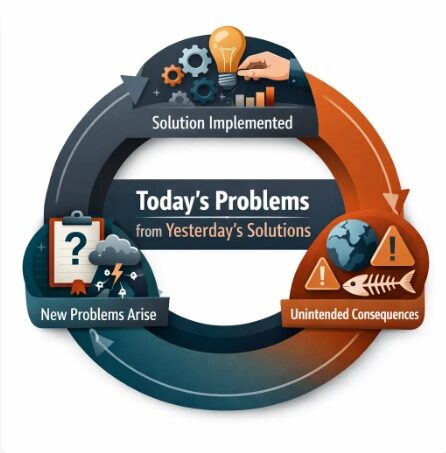

Today's problems come from yesterday's "solutions."
In his seminal work, Peter Senge identifies five essential elements—or disciplines—that define a learning organization: Personal Mastery, Mental Models, Building Shared Vision, Team Learning, and the "Fifth Discipline" itself, Systems Thinking. Senge argues that without an understanding of the whole system, our attempts to fix isolated issues often backfire. This is most poignantly captured in his first law of systems thinking:
"Today’s problems come from yesterday’s solutions. Often we are puzzled by the causes of our problems; when we merely need to look at our own solutions to other problems in the past." [1]
In the context of modern Knowledge Management (KM) and AI, this law warns us that the technology used to solve "information overload" today is quietly sowing the seeds for systemic crises tomorrow.
The AI "Rug Merchant" and Knowledge Decay
Senge illustrates his first law with the story of a rug merchant who steps on a bump in his carpet to flatten it, only for the bump to reappear elsewhere. In KM, we "flatten" the bump of data complexity using AI synthesis. However, a new bump emerges: Cognitive Atrophy.
Cognitive Atrophy is the gradual weakening of mental faculties—such as critical thinking and analytical reasoning—resulting from the long-term "offloading" of these functions to automation. By solving for speed today, we risk a future where the workforce loses its "intellectual muscle," becoming entirely dependent on automated systems for insight. [4]
Compensating Feedback in Organizational Trust
The harder we push AI to provide "instant answers," the harder the system pushes back. This "compensating feedback" manifests as Truth Decay. When AI-generated errors pollute an internal knowledge base, trust in the organization's information collapses. Recent studies show that these human-AI feedback loops can fundamentally alter our social and perceptual judgements, making the recovery of trust even more difficult. [2]
Shifting the Burden to the AI Intervenor
Systems thinking identifies a dangerous pattern called "shifting the burden to the intervenor." We often shift the burden of critical analysis from our internal experts to AI "helpers." Over time, the intervenor’s power grows, while the organization's ability to shoulder its own intellectual burdens—specifically the preservation of Tacit Knowledge—is fundamentally weakened. [3]
Seeing the Whole Elephant
To understand the systemic impact of AI, we must stop dividing the "KM elephant" into silos. These departments are part of a single, interconnected system. Only by looking at the whole can we ensure that AI strengthens the organization's relationship with its own knowledge rather than replacing it. [1]
A Generational Crisis of Competence
The systemic impact of AI is not distributed equally across human generations. There is a strong argument that people currently older than 25 stand to benefit most from AI because they possess a "pre-AI" cognitive foundation. They spent their formative years before 2023 having to synthesize information, solve problems, and practice critical thinking manually. Conversely, we face a significant systemic risk regarding the current youth—those aged 13 to 24. Without the historical necessity to struggle with complex thought, there is a danger that this younger generation may develop a diminishing capacity for critical analysis. This generation runs a risk of losing the very critical thinking skills required to manage the AI they so heavily rely upon.
I'm calling this hypothetical phenomenon 'AI-diocracy' "A state of systemic societal decline characterized by the atrophy of human critical thinking and analytical faculties due to an over-reliance on Artificial Intelligence. It specifically refers to a generational "cognitive cliff" where individuals who did not develop a "pre-AI" intellectual foundation—defined by the manual synthesis of information and the struggle with complex problem-solving—become incapable of managing or overseeing the very technology upon which they depend".
The Verdict: The goal in the AI age is to apply the Fifth Discipline to ensure our technological "solutions" do not become the very obstacles that prevent us from learning.